
Family Handbook
Montlake Family Handbook
PAWS Pact: Montlake Wolves are Prepared, Advocates, Welcoming and Safe
School Vision: To educate the change-makers of tomorrow
School Mission: Montlake Elementary is an inclusive community of students, families and educators dedicated to creating a welcoming and equitable learning space for independent thinking, creative expression and advocating for a better world.

Montlake Elementary Family Handbook
Revised September 2026
About Us:
Montlake PAWS Pact: Montlake Wolves are Prepared, Advocates, Welcoming and Safe
School Vision: To educate the change-makers of tomorrow
School Mission: Montlake Elementary is an inclusive community of students, families and educators dedicated to creating a welcoming and equitable learning space for independent thinking, creative expression and advocating for a better world.
Office Staff
Katrina (“Tina”) Wood, Principal: 206-252-3300 kawood@seattleschools.org
Miriam De Leon, Admin Secretary: 206-252-3300 mrdeleon@seattleschools.org
Missy Pody, Elementary Assistant: 206-252-3300 mapody@seattleschools.org
Darci Wiebke, School Nurse (here on Thursdays): 206-252-3307 dlwiebke@seattleschools.org
The school office is open between 7 a.m.-3 p.m.
Websites
Montlake Elementary: montlakees.seattleschools.org Seattle Public Schools: seattleschools.org
Helpful District Contact Information
Transportation Office: 206-252-0900 or transdept@seattleschools.org Admissions & Enrollment: 206-252-0760 or admissions@seattleschools.org Special Education: 206-252-0058 or specialed@seattleschools.org
English Language Learners (ELL) Services: 206-252-0072 or mota@seattleschools.org Nutrition Services: 206-252-0675 or nutritionservices@seattleschools.org
Advanced Learning: 206-252-0130 or advlearn@seattleschools.org
Your child’s school day at Montlake
(1) Getting to and from school
Car drop off and pick up; Parking & Visiting information:
For safety and efficiency, please:
- Use East Calhoun Street for drop-off and pick-up. Our bus load/unload zone is on McGraw Street.
Montlake’s main entrance is on East Calhoun Street.
- At the start and end of the regular school day, families should park in the neighborhood and enter the building through the main entrance.
- If you are dropping your child off / picking your child up by car, please drive eastbound only on East Calhoun Street.
- When visiting the building during the school day or picking your child up from school, please park in the neighborhood and walk up to the main entrance.
- Please respect our neighbors. Do not park in front of or block residential driveways.
School bus service:
For information about transportation, please visit the Transportation page on the school district website.
- Bus problems? For bus issues, contact the district transportation office at 206-252-0900 or transdept@seattleschools.org (be prepared with your route number and student ID number).
- Late or missed bus? When a bus is late, the bus or replacement bus should complete the run as soon as possible. If a student misses the bus, the parent/guardian is responsible for getting him/her to or from school. Please make sure you have a back-up plan for missed buses and that your child knows the plan!
- Going home on the bus with a friend or getting off at a different stop? To send your child home on a bus with a friend, submit a request via e-mail to our Attendance Secretary before 8:30 a.m. at montlake.attendance@seattleschools.org to get a temporary bus card.
Walkers and Independent Walkers:
- Families who are walking their student to school should enter at the SE corner (garden) gate. Families are welcome to walk up to the learning terrace and wait with their student.
- If you would like your child/ren to walk home independently after school, please send an email stating your permission to do so to their child’s teacher and copy both Principal Wood and the Attendance Office at Montlake.attendance@seattleschools.org. In these cases, we ask that students head straight home and not remain on the play structure, as we cannot provide supervision.
Morning Drop-off and Afternoon Pick-up:
- Please see maps below as line-up and gathering spots change based on time of day.
- Morning Drop-off: Students enter through the SE (garden) gate and head down to the playground where their teacher will meet you for hand-off. If you’re walking your child to campus from home or your parking spot, you may accompany them to their waiting zone and remain up until the bell rings.
- Afternoon Pick-up and Play structure: While we don’t provide after-school supervision, you’re
welcome to stay and enjoy the play structure with your child as long as you’re actively supervising. The playground will be in use by Launch from 3:30–6 p.m., after which time we hope to open it up to the community. For safety reasons, the upper Playfield will be locked between 2:25 p.m. and 7 a.m, daily.
Beginning of Day Map:
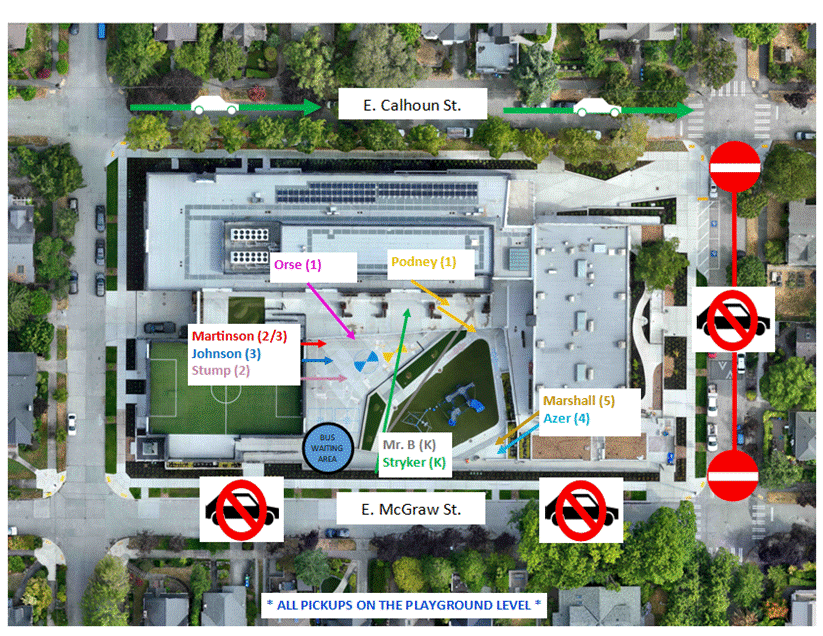
End of Day Map:
Snow days and other school closures. When there is snow or another unforeseen weather event, there may be school closures. Decisions are made no sooner than 5 a.m. each day. Note that door to door bus services for Special Education students are cancelled on 2 hour delayed days.
School closure or delay information (typically two hours late) is widely available from most major radio and television stations. The District will use SchoolMessenger, the automated telephone and email system, to alert you of schedule changes. You may also:
- visit Seattle Public School’s main website;
- call the 24-hour SPS News and Information Line at 206-252-0207;
(2) Attendance and supervision
Seattle Public Schools believes that maximizing instructional time is critical to the success of our students. Washington State law requires all students to attend school daily unless they are unable to do so (see Absent from school? below).
School Hours: School starts at 7:55 a.m. daily (welcome bell is at 7:50 a.m. and tardy bell is 7:55 a.m.). Students will be received onto the learning terrace where they will be supervised from 7:35 a.m. Children arriving earlier will not be supervised.
School ends at 2:25 p.m., except on Wednesdays, when school ends at 1:10 p.m. Supervision ends at 2:35 p.m. (1:20 p.m. on Wednesdays). Children leaving later and who are not enrolled in after-school care will not be supervised.
- Late to school? If your child arrives at school after 7:55 a.m., they must first come to the office to check in and receive a late dot before going to class.
- Leaving early? If your child needs to leave school early, please check in at the office at the time you need to collect your child, and they will be called from class to meet you. When you arrive, please sign your child out in the Early Dismissal file folder on the front desk and take a Temporary Dismissal slip to give to their teacher. Please also email montlake.attendance@seattleschools.org by 7:30 a.m.
- Absent from school? If the absence is planned, contact the office for a pre-planned absence form at least three (3) days in advance. Please report all absences to the office at 206-252-3304 or montlake.attendance@seattleschools.org. If the absence is unplanned, let the school (both your teacher and the attendance mailbox) know before 8:30 a.m.
Excused vs unexcused absences: Whether planned or unplanned, absences may be considered excused or unexcused. Excused absences include student illness or injury; illness, injury or death of family members; health and therapy appointments and religious observances. The full list of excused absences is available on the Seattle Public Schools website. It is also included in the Appendix at the end of this handbook. All absences that are not on the list of excused absences are considered unexcused.
If your student has more than 5 excused absences in a month (without prior notice to the school or provision of a doctor’s note afterwards), or more than 3 unexcused absences in a month, the school is required to schedule a conference with you and your student to identify any barriers to attendance and supports that may be needed. After 7 unexcused absences in a month or 10 during the school year, the school is required to file a court petition to help resolve the student’s attendance concerns.
After-school and holiday care: After school care is available at LAUNCH located on the Montlake campus, Monday through Friday. Please visit the Launch website for more information about the program. For more information, call 206-636-9220 or e-mail montlake@launchlearning.org.
(3) Health and Safety
If your child has a life-threatening health condition: Washington State law requires that when there is a student with a known life-threatening health condition, schools must be prepared for a life-threatening event on the day the student starts school. Please fill out appropriate forms and take needed medication(s) to the school before your child’s first day of attendance. These documents need to provide current information and should be prepared after July 1 for the following school year.
If you have any questions about this process, please contact our school nurse, Darci Wiebke, at 206-252-3307 or via email dlwiebke@seattleschools.org. You can find more information about management of student health conditions at school by visiting the district’s Students with Health Conditions page.
If your child needs medication at school: State Law forbids school personnel to administer medication or treatment (other than first aid) to any child without written permission from the child’s physician on a school form. Medication must be in the original bottle with clear instructions from your doctor.
If your child is ill: Do not send your child to school if she/he is ill. Some danger signs include temperature 100.0 degrees Fahrenheit or above, sore throat, pain, rash, diarrhea or vomiting. It is safer for your child and other children if you respond to symptoms before she/he leaves for school. Do not send your child to school until 24 hours after the last symptom (vomiting, diarrhea, fever) has disappeared without the use of medications.
If your child falls ill or is injured at school: Our school nurse is on-site one day per week, and on days when she is not present, our main office team responds to student illnesses and injuries. Neither may diagnose or give treatment other than first aid. If a student cannot continue their normal school day because of illness or injury that is not life-threatening, our administrative secretary or elementary assistant will call the contact listed on the student’s record. Injured or ill students will stay in the main office until they are picked up by a parent or caregiver.
If your child has head lice: Infection control experts have determined that head lice are not a health hazard and are not responsible for the spread of any disease. The CDC no longer recommends that students be excluded from school. If the school finds lice or nits on your students, you will receive a phone call informing you. You will have the option of picking your child up immediately or having them stay in school until they are able to be transported home. Please treat your student to prevent the spread of lice as soon as possible.
If there is a disaster during school hours: Our staff are trained to be able to handle any given situation until help arrives. We have staff members who are CPR/First Aid certified; we conduct regular disaster-
preparedness training including earthquake and active shooter drills; and we have assigned roles in the event of an emergency (command control, communications, first aid, or search and rescue).
If an emergency does occur, coordination with police, fire, and rescue is the top priority. Classroom teachers will stay with their students until another capable adult relieves them. There will be a checkpoint in the school office for pick-up and formal release procedures to assure the safety of every student. Please remember:
- Students will only be released to people listed on the Emergency Information and Student Release form.
- Parent/caregiver or emergency contact ID will be required to pick up children. If you work outside of the neighborhood, it is a good idea to include as an emergency contact a neighbor or someone who lives close by. Please be sure to keep your child’s emergency information up to date.
- Do not go directly to get your child, as this creates confusion.
- Do not call the school to inquire about your child. Telephone lines need to be open so that school personnel can communicate with district and emergency services.
You can find a copy of our Family Reunification Plan our school website. Please take some time to become familiar with it. Our Safety Team is currently updating this plan for our new location.
Safety drills. We conduct whole school drills every month. Drills include fire, earthquake, and shelter-in-place/lockdown. Shelter-in-place is for when there is a potential threat in the neighborhood, but learning happens as usual while we keep everyone inside and continue classes. A lockdown implies a direct threat to the building, and all classroom doors are locked, lights are turned off, and students are kept away from windows.
Teachers describe these drills to students in developmentally appropriate ways, balancing the need for students to take them seriously with a desire also not to frighten them unnecessarily. Families are informed by School Messenger any time we have a Lockdown Drill. Interested families may participate in some emergency preparations via our internal School Safety Committee (see Family Partnership & Leadership Opportunities below).
(4) School climate
What are the school’s expectations of scholars? The overall goal of all discipline at Montlake is to instruct students in the skills necessary for effective self-discipline and to encourage students to become self-managers. Elementary school is an important time for learning how to be in community with others. Guided by the school-wide Positive Behavior Intervention Supports (PBIS), we make decisions to support students in learning the expectations and behaviors to support a positive learning environment. We have three key pillars to PBIS to support safety and social-emotional learning: Expectations, Acknowledgement, and Interventions. As far as they are able to at their particular stage of development, students are expected to strive to embody the Montlake PAWS Pact – to be prepared, advocates, welcoming and safe. We have developed guidance to help students remember how to follow the PAWS Pact expectations in common areas of the school: in assemblies, in the lunchroom, in bathrooms and hallways, and in the playground. Acknowledgment has to do with positive reinforcement efforts including PAWS Tickets, Wolf Pack Celebrations, Monthly Wolf Pride Assemblies (student recognition awards), and attendance incentives. Interventions include following our Montlake Behavior Flow Chart and District Discipline Matrix to support students as needed and Student Intervention Team meetings. We will work closely with the counselor, interventionist, teachers, special education staff, families, and with the school administrator to develop appropriate, consistent interventions to address behavior concerns. It is the teacher’s responsibility to inform parents of on-going behavior concerns. Please feel free to ask your student’s teacher for an update at any time.
At the beginning of each year, students work together with their teacher to establish expectations for themselves and each other through the process of designing a Classroom Charter. These charters are posted prominently in classrooms and provide year-long guidance for classroom climate management.
Bringing items from home:
Please be aware that the school will not be responsible for loss or theft of personal items. Students bring items from home is at their own risk.
Cellphones and Apple Watches. Cellphones and watches are discouraged at school as they may be lost or stolen (for which the school is not responsible) and present a distraction. If they are brought to school, they must remain off and out of sight during school hours, including lunch and recess between the hours of 8 a.m. and 2:25 p.m. During state testing cellphones and watches must be left with the teacher or the office during school hours – no exceptions. If a student’s phone or watch is found to be powered on or in use during the school day, the teacher will confiscate the phone or watch and return it to the student at the end of the school day. If a student is found a second time with their phone or Apple Watch out or on, the phone or watch will be confiscated again, and a parent will have to come to school to pick it up from an administrator.
Other items: Electronic readers (e.g. Kindles, Sony Readers, Nooks, etc.) are not allowed at school. Students should not bring toys form home or game cards such as Pokemon or sports cards to school.
Sensory items: Sensory tools are not considered toys. They are tools. A sensory tool must be agreed upon by the teacher, parent, and student, and used appropriately. Teachers may ask students to put a sensory tool away if it is becoming a distraction from learning rather than a tool that supports a student’s focus on learning. If an item causes distraction, disruption or lack of safety at school, it will be sent home. Items sent home should not return to school.
Consequences:If a student does bring any of these items to school and a staff member sees it, they will give the student a warning to return the item to their backpack. If the student brings out the item a second time, the student will need to give the item to a staff member and it will be returned at the end of the school day or at an appropriate time. If there is a third instance, the item will be labeled with the student’s name and kept by the staff member until a parent/guardian comes to pick up the item, or until the last day of school.
What opportunities exist for students to provide feedback and be involved in decision-making? Currently, students in Grades 3-5 fill out an annual Student Survey that is collected by SPS; previous results can be found on the district’s School Climate Surveys webpage.
What opportunities exist for organized student leadership? As part of our commitment to personal success and public stewardship, Montlake offers multiple opportunities for students to participate in leadership and assistance roles throughout the building:
Green Team: Students and staff work together to lead efforts to integrate sustainability into all aspects of our school. As part of the Washington Green School movement we are certified as a Washington Green School in composting, recycling and energy. More information about EarthGen
Student Council: Student Council is a student-run leadership group made up of students from all grade levels. Some of the roles of Student Council include planning spirit days and activities, promoting positive behaviors within our school community, and other activities decided upon by the members. Working on service projects in the larger community is a long-term goal of the Council. Members of Student Council are expected to be role models and leaders in the school and will be responsible for communicating plans with the greater school community. Meetings and activities are overseen by Principal Wood.
Library Aides: Students volunteer each year to work during recess in the library to assist our Librarian.
Patrol: Teams of students arrive early and/or stay late after school to patrol our crosswalks and assist walkers in safely crossing the neighboring streets. Patrol Students must be at least 10 years old, demonstrate responsibility and leadership, and be willing to follow directions. We have currently suspended this group due to the move but expect to reinstate it sometime in the future.
(5) Academics
Curriculum.
English Language Arts (ELA)
Montlake Elementary uses the Seattle Public Schools’ newly adopted Emerge curriculum. Following a comprehensive review of three high-quality curriculum programs, the adoption committee recommended McGraw Hill’s Emerge!, which was formally approved by the Seattle School Board for a seven-year adoption.
Emerge! was selected for its strong alignment with the science of reading, with a structured literacy approach that develops foundational skills while also strengthening language comprehension. The adoption committee highlighted the curriculum’s integrated design for reading and writing, flexible supports to meet the diverse needs of learners, and a thoughtful commitment to culturally responsive topics and inclusive authorship across grade levels.
Math
Montlake Elementary uses the Savvas enVision 2020 mathematics curriculum for K-5 math instruction. This Common Core State Standards-aligned curriculum emphasizes the development of all students as mathematicians through the development of Math Practices – the habits of mind, processes and
dispositions that enable a learner to understand mathematics and to use or do mathematics with understanding.
The curriculum allows educators to easily deliver differentiated instruction to all learners as they progress toward becoming fully proficient mathematicians. It is engaging and emphasizes a variety of problem-solving strategies, and also includes optional home-based digital learning modules for students who wish to practice their skills further.
Science.
Adopted in the 2020-21 school year, Montlake Elementary now uses the Seattle Public Schools standard Amplify Science curriculum. Amplify Science’s instructional model is aligned with the Next Generation Science Standards and allows students to access their prior knowledge and to connect past learning experiences to the present. Students have the opportunity to ask questions and define problems about the natural and designed world, design investigations in which they collect and analyze trends and patterns in their data, engage in argument form evidence in both writing and through discourse with their peers, develop conceptual scientific models of physical phenomena, and to communicate their findings from their investigations.
Social justice/antiracist education. Each year, Montlake Elementary observes Black Lives Matter at School week with tailored instruction to all grades using the joint SEA and SPS BLM materials and resources. In 2020-21, our staff Racial Equity Committee began working to create a schoolwide curriculum of social justice lessons at every grade level using materials from Learning For Justice (formerly Teaching for Tolerance). Our school-wide assemblies are based on these themes.
Social and emotional learning (SEL): The Second Step® Elementary digital program includes four age-appropriate units per grade (1. Growth Mindset & Goal-Setting, 2. Emotion Management, 3. Empathy & Kindness, 4. Problem-Solving), each with weekly scripted lessons and downloadable handouts to support student engagement. Every unit contains five 15- to 30-minute, teacher-led lessons available in English and Spanish, with the final lesson serving as a performance task where students demonstrate their learning.
R.U.L.E.R. is a social/emotional curriculum approach created for students (and adults) to teach them how to Recognize, Understand, Label, Express, and Regulate emotions. It has been met with success and lasting positive results for students and teachers who have implemented it in their schools and is now in use at over 50 Seattle Public Schools elementary and middle schools. Montlake Elementary has used the R.U.L.E.R. curriculum since 2015.
Using R.U.L.E.R., each year we create classroom charters that will be continually referenced and updated throughout the year. The three components of this charter are:
- How do we want to feel?
- What will we do to have these feelings consistently?
- What will we do to prevent and manage conflict? (What do we do when the charter isn’t followed?)
Other strategies we teach include the use of the Mood Meter (below), which gives students a tool to understand and explain how they are feeling on a continuum of pleasantness and energy; the Meta Moment for taking a pause and imagining how they would want to handle something as their “best self”; and the Blueprint, which helps them to build empathy by considering another person’s perspective.
For more information about R.U.L.E.R. in SPS, please visit the district’s R.U.L.E.R. information page online.
Differentiated learning for all students: Seattle Public Schools has made a shift in practice to emphasize integration of both academics and behavior as critical to student success. SPS uses the Multi-Tiered System of Support (MTSS) approach to support all learners and ensure equitable access to a robust, high-quality education. MTSS is an evidence-based model of educating students that uses data and problem-solving to integrate academic, behavioral, and social/emotional instruction and intervention to maximize the success of all students. MTSS is not the same as Special Education. The structure of the MTSS model is illustrated below:
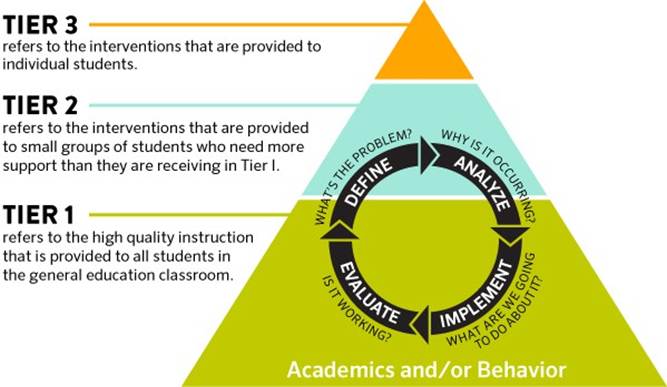
Instruction and intervention is provided to students across multiple tiers of intensity based on need. Staff make data-based decisions in order for resources (e.g., time, staff, and evidence-based strategies) to reach the students at the appropriate levels to increase the performance of ALL students, with the goal of achieving and/or exceeding proficiency.
Family involvement is an essential component of the MTSS approach. Research shows that parent and
caregiver engagement in a child’s education is an important predictor of academic success. We provide
multiple opportunities for families to partner with us to support their child’s academic and social-emotional development both during the school year and throughout each student’s time at Montlake Elementary.
Special education and support services:
Resource Program: The Resource Program serves students in need of mild-to-moderate support with academics, social skills, and organizational/study skills. The majority of each student’s day is spent in the general education setting. Services are dependent on the individual needs of the student. Instructional supports may often look like small groups or in-class support. Students generally receive supports from a certified Special Education teacher and an Instructional Assistant, though staffing may vary from year to year due to budget constraints. The program staff ratio is 18 students: 1 certified teacher.
Extended Resource Program: The Extended Resource Program (formerly known as Access) serves students in need of more moderate-to-intensive supports in academics, social-behavioral and organizational/study skills. Services may vary from small group, to individual 1:1 lessons, to in-class support. Students in the Extended Resource Program are served by a certified Special Education teacher and 3 Instructional Assistants throughout the day. The program staff ratio is 10 students: 1 teacher: 3 Instructional Assistants.
Focus Program: Students with the Primary Service type of Focus receive specially designed instruction (SDI) addressing their intensive academic and functional needs. Students have opportunities to participate in the general education curriculum through specially designed instruction at their present level of performance. Instructional content varies, based on each student’s IEP. These students benefit from spending a majority of their instructional time in a smaller group setting as their least restrictive environment (LRE), but this can vary by IEP. The program staff ratio is 10 students: 1 teacher: 2 Instructional Assistants.
Benefits for All Students of Access and Resource Programs at Montlake; Having three Special Education programs has many benefits to the Montlake community. At Montlake we recognize these benefits and they are celebrated throughout our school:
- Special education instructional assistants providing in-class instruction allows all students the benefit of more than one teacher and opportunity to collaborate amongst faculty.
- Instructional assistants are often supporting students on the playground, increasing safety in play through monitoring, and conflict resolution skills of all students.
- Affords a sense of belonging, ownership, and membership in the Montlake community.
- Provides a diverse and stimulating environment in which to learn.
- Enables friendship development with typical peers.
- Enhances self-esteem, acceptance, and tolerance of others.
- Inclusive practices destigmatize disabilities and reduces negative labeling and stereotyping.
- Provides peer models.
- Natural opportunities to practice social and language skills.
- Access to general education curriculum for every student.
Least Restrictive Environment & Placement Determination: Least restrictive environment (LRE) is part of the of Individuals with Disabilities Act (IDEA) federal law that requires public schools to guarantee a Free Appropriate Public Education (FAPE) to students with disabilities in the most inclusive setting possible. The LRE defines where and how special education services (specially designed instruction) are provided.
A student’s least restrictive environment and placement is determined by the student’s IEP team following an
annual review or an initial evaluation.
Other SPS Special Education Service Pathways: Seattle Public Schools offers other programs at various buildings within the district that provides different services based on student needs:
- Focus: Offers intensive academic and functional needs. Majority of instructional time is in a small-group setting
- Distinct: Intervention and services differ greatly from general education curriculum. Services include academic, functional, communication, and life skills.
- SEL (Social-Emotional Learning): Support of individual development in behavioral, social-emotional, academic, and functional skills. Services are often delivered in a small group setting.
- Deaf/Hard of Hearing (DHH): Offers instruction with accommodations and modifications of the general education curriculum for students with hearing impairments.
- Blind/Visually Impaired (Vision): Offers instruction with accommodations and modifications of the general education curriculum for students with visual impairments.
- Medically Fragile: Students with intensive medical needs benefit from a concentration of services or specialized facilities outside their assignment area
For more information, see the Placement and Primary Service Types page on the SPS website.
Advanced Learning Opportunities (ALO):
Classroom Differentiation: At Montlake Elementary, we have high expectations for all students, and we know that each will be challenged by the rigor and depth of our curriculum. To that end, Montlake follows an inclusion model in which teachers differentiate instruction for all students. Current research shows that inclusion is generally best educational practice for all learners, including advanced learners, especially in math.
An inclusion model is also consistent with the Seattle Public Schools’ Strategic Plan focus on “undoing legacies of racism in public education.” The following are various strategies we use to meet the needs of all learners, including those identified as advanced either by their teachers or district testing.
ALO Math Strategies: Montlake utilizes the enVision Math 2020 curriculum, which builds conceptual understanding through a combination of problem-based and visual learning strategies. Teachers implement differentiated instruction in varied groups: whole class, small group, partners, and individual. Listed below are instructional strategies used at Montlake (note that not every strategy will be used in every classroom):
- Parallel Tasks: All students work on the same core content with tasks of different complexity.
- Curriculum Compacting: Use assessment to determine student skill level in a core content area. Then eliminate or enhance parts of the curriculum based on instructional need.
- Flexible Groups: Students are grouped by interest, achievement, activity preference, or specific instructional needs.
- Math Centers and Games: Activities in small groups based on student choice or teacher designation.
- Small Group Instruction: Teacher works with a small group of students on a targeted learning goal.
- Tiered Assignments: Adjusted degrees of difficulty of a question, task or product to match student’s
current readiness level.
- Open Questions: A question framed in such a way that a variety of responses/approaches are possible.
- Targeted Questioning: Teacher is intentional about depth of questions asked. All students are asked questions that require critical thinking at a level that is challenging for them, and all students benefit from hearing their peers’ thinking.
ALO Reading Strategies: The strategies listed above are also adapted for use in reading instruction. We use a wide variety of reading materials from our classroom and school libraries, teacher read-alouds, and content area reading. Classroom groupings include:
- Study Groups and Focus Groups (K-5): Utilizing the Emerge! curriculum, students are placed in groups by current reading level, skill, or need to ensure appropriate instruction and reading materials. Groups can change as students’ reading skills develop.
- Independent Reading: Each student will have an opportunity for self-selected reading during the school day to develop reading fluency and get in the habit of reading.
- Support for Students in Selecting Appropriate Books: Teacher will guide students in choosing just-right books for independent reading. (Criteria include instructional level, high-interest reading, and student choice.)
Teachers may also use the following differentiated approaches to support the ALO Reading Strategies above:
- Reading Logs: Students keep a reading record to allow both student & teacher to monitor choices.
- Independent Book Study Projects: Opportunities for students to explore a topic of interest to them.
- Book Reports (2-5). Depth of student analysis and comprehension is appropriate to student reading level.
- Response to Literature: Opportunities for students to demonstrate understanding by using text to make connections and support thinking. Projects could include art, drama, writing, reports or other presentations.
- Extension Menus: Developed in conjunction with members of a grade level team, students choose an option from a predetermined “menu” of options (or propose an alternate option) that allows them to demonstrate and extend their learning.
- Genius Hour: Students choose a topic of their choice, research it, and create an innovative project and presentation using the Genius Hour model. Past topics have included video games, learning sign-language, designing buildings, starting businesses, and changing the world.
For more information about Advanced Learning Opportunities, please visit the Seattle Public Schools Department of Advanced Learning.
Homework policy: We believe that all children K-5 benefit from a rich reading life at home. We encourage at least 20 minutes of daily reading, which can be a combination of looking at picture books, reading with an adult, reading independently, or other reading activities.
Brain research also shows that repeated exposure to math concepts is beneficial. As a result, we want students to do some math work at home as well. That can be something the teacher sends home that matches the day’s lesson, or it can be something that a family chooses–playing go fish, counting coins, working on math facts, playing chess, talking about time, etc. You can find additional ideas for supporting your mathematician at home by visiting SPS’s elementary math family support page online. Rich resources especially designed for elementary mathematicians and their families are also available online at the SPS website.
Special Projects–Sometimes a teacher will assign special projects at school that require a little prep work at home. Examples include interviewing a family member, thinking of ideas for a science project, practicing lines for a play, etc.
How long should homework take? Homework will only be given for Monday through Thursday, but it can be done anytime. We know children today have many activities, and some nights are busier than others.
Here are rough time guidelines:
- 20 minutes of reading plus 10 minutes of math for K-1
- 20 minutes of reading plus 15 minutes of math for 2-3
- 20 minutes of reading plus 20 minutes or math for 4-5
What is the process if I have questions about my child’s homework? Homework is encouraged at Montlake but not required. Students will not lose recess or class points or have other consequences for incomplete homework; however, it is a missed learning opportunity. For example, students will certainly read and do math at school, but the extra time reading at home, either alone or with a family member, is lost time if it isn’t done. Homework can also be informative and can help families understand how their child is doing at school.
Teachers at Montlake want to work with families so that children and parents are enjoying learning at home and we are open to alternate assignments. Please talk to your child’s teacher if you have questions.
Standardized testing: The Seattle School District has developed specific and detailed academic standards for all grades. Student academic achievement is reported three times a year, using a standards-based student progress report (which can be found online at The Source). Parent-teacher conferences are held in the fall.
Teachers and specialists are also available for individual conferences throughout the school year in order to promote academic success for each child.
The following standardized tests are used by the school and district to evaluate student performance:
- Grades K: MAP (Measure of Academic Progress) ELA and Math – Winter and Spring
- Grades K: DIBELS (Dynamic Indicators of Basic Early Literacy Skills) – Winter and Spring
- Grades 1-5: MAP (Measure of Academic Progress) ELA and Math – Fall and Spring
- Grades 1-2: DIBELS (Dynamic Indicators of Basic Early Literacy Skills) – Fall, Winter and Spring
- Grades 3-5: Smarter Balanced Assessment (SBAC) / ELA and Math – Spring
- Grades 5: Washington Comprehensive Assessment of Science (WCAS) – Spring
Parents of students 3-5: Please make every effort to avoid appointments and travel plans during the SBA testing period. Scheduling make-up sessions is difficult as we need to rearrange many different schedules to accommodate the make-ups.
Tutoring: Please note that it is a violation of the SPS Ethics Policy for your current child’s teacher to tutor your child for a fee.
(6) Outside the classroom
Lunch and recess:
How long is the lunch period and how does it work? Each grade has a 20-minute lunch period rotation as follows: First Grade: 11:15, Kinder: 11:35, Fourth/Fifth: 11:55, Second/Third: 12:15.
Teachers and other staff members will help students build a common understanding of good habits while eating lunch:
- Students will be reminded to wash their hands or use hand sanitizer before and after lunch. Time has been included in the schedule for handwashing and/or sanitizing before and after lunch.
- Students will be encouraged to use quiet indoor voices while at lunch. Stories will be enjoyed at lunchtime.
Please help us prepare by talking with your student about these habits and expectations prior to the first day of school.
Snacks during the school day: Individual teachers may allow students to eat snack in classrooms.
Please be sure to have your child dress for the weather (extra warm coats and hats are best). If you need assistance with any of these items, you are welcome to reach out to our school counselor Jamie Coughlin at jacoughlin@seattleschools.org
How many recesses are there during the day and how long are they? All grades have two fifteen-minute recesses. This follows OSPI and district requirements. Students have the opportunity for additional outdoor time as organized by their teachers including gardening, movement breaks, and enrichment.
School meals: This year, thanks to a new partnership with the City of Seattle, free meals will now include all students at all schools.
As a result, every SPS student at every school can now receive:
- One free breakfast each school day
- One free lunch each school day
Meals are provided at no cost when they meet U.S. Department of Agriculture meal program requirements. Additional items, snacks, second entrées, or individual items that are not part of a complete meal may be charged separately.
What Families Need to Know: Even though meals are free, students must continue to enter their information when receiving a meal by scanning their student barcode or entering their student ID number at the cafeteria point of sale. This process supports required meal-program records and funding.
Please Complete the CNEEB Application: While school meals are available to all students at no cost, SPS encourages every family to complete the Child Nutrition Eligibility & Education Benefit (CNEEB) application. The information helps schools receive important funding and resources and may qualify students for additional educational benefits. Families who do not wish to provide income information may select the “Decline Benefits” option.
Learn More: Learn more about school meals and the CNEEB application on the SPS Culinary Services webpage.
What if my child has a food allergy? Information about potential allergens in school meals is available from the SPS Culinary Services department. Our lunchroom provides a separate table for students with food allergies. Information about student food allergies must be provided to our school nurse prior to the start of the school year (see If your child has a life-threatening health condition, above).
Snacks and classroom food: There is no set schedule for morning or afternoon snacks, and provision of a snack break is at the discretion of each teacher. Some teachers may invite families to contribute bulk snacks for their class where possible.
In-class parties: Due to a growing number of students with severe, life-threatening food allergies, and a desire to be fair to all students, Montlake will no longer celebrate birthdays with food. Each classroom will decide how they want to celebrate birthdays without food. It could be a special game or other event, but we know that it is fun for kids to be special on “their” day and it doesn’t need to be about the food. You can find out how your child’s classroom celebrates students’ birthdays from your child’s teacher. If you have any questions about this policy, please call our school office at 206-252-3300. Thank you for your cooperation.
Field trips. Field trips provide a fun way to enrich and enhance classroom learning. Parents must sign a release form before a child can attend any field trip. Where field trips involve a cost, scholarships will be made available for students. Please discuss any transportation issues with your child’s teacher in advance. See below for more information about becoming an authorized field trip chaperone.
Playground rules and procedures:
- Down-only on the slides, feet first, one person at a time.
- Jumping from the play structure should not happen from any place higher than half your height.
- Jump-ropes stay on the ground and are used next to the lunchroom wall.
- Large balls from home are fine as long as anyone can play with you – small balls are not allowed.
- Never leave the playground without permission.
- If you need help, find an adult.
- Remember Montlake’s “Hands-Off Policy” (hands, feet, and mouth to ourselves).
- Balls and other items should be returned to the ball box next to the lunchroom at the end of recess.
Lost & found. Lost & Found is located by the front doors of the school in the closet, as well as in the cafeteria. Please mark all clothing and personal belongings with your child’s name. Our valued volunteers do their best to match items with owners, but this is a difficult task without names in clothing. All unmarked and unclaimed items will be donated before winter break, after spring break, and at the end of the school year.
(7) Student privacy
Video/photography at Montlake Elementary: Family rights under FERPA. The Federal Family Educational Rights and Privacy Act (FERPA) gives families certain rights in relation to information about their student/s. Each year, our school will collect a FERPA form on which families can opt out of the collection and sharing of images (such as photographs and video recordings) and other information about their student/s by school staff during the school day. This permission also applies to images recorded by other district entities, our PTA, and other outside organizations.
You can find our School Board’s policies and procedures around student information privacy (including
photographs and video recordings) on the SPS website:
Recording by private individuals – recommended etiquette. FERPA does not apply to images captured by
individual parents or other private individuals. FERPA only applies to acts by an “educational agency or institution”. However, family preferences about images of children vary, and in some circumstances the
sharing of photographs or video recordings may place a child and their family in danger (for example, where a child or family is under a protective court order). As such, we ask families to please observe the following etiquette around capturing images of students:
- Refrain from intentionally capturing images of students (other than your own) without first consulting with school staff or a parent or guardian of the student/s.
- Staff, parents, and students should immediately alert a staff person if they notice unfamiliar people taking pictures or videos of students on school grounds.
- If video or photography captured on school property documents an unsafe behavior, this should be reported immediately to school staff.
This document contains more information about photography and video recording under FERPA.
(8) Family-school communication and partnerships
Weekly Update: The Montlake PTA and the Montlake school send a join weekly newsletter on Tuesdays of each week.
Communicating effectively with your child’s teacher: Parents can expect all staff to read their emails daily and to respond to emails from parents within 48 business hours unless a staff member is on vacation or on leave. Please schedule appointments for discussions with teachers. As you can imagine, in the mornings, teachers are trying very hard to get ready for the day. They won’t mind a brief conversation every once in a while, but it would be best to schedule a time if you need to have a conversation, instead of “dropping in” before the bell.
We want to give parents and caregivers the time and attention your discussions/conversations deserve. Please email the teacher with some dates and times that are convenient for the two of you to meet. We ask that should a parent have a concern regarding their child’s teacher that it is most respectful to share a concern/issue with their child’s teacher first and work towards a resolution before going to the principal. An exception of course is that the principal should be contacted about any issue that is a safety or security concern.
Contacting staff: To contact a specific staff member, please refer to the contact list in the Appendix to this handbook.
Office telephone use: Students must have permission to use the office phone. Students are not to use the office telephone at school except in emergencies. Please plan ahead when scheduling and communicating with your child. Make sure that your child is aware before school each day of any after school classes, after school routing changes, and especially on early release days, make sure they know that you are aware of the early release. Send notes to their teacher of any changes (e-mail works best, and please copy the office), as written permission is required. Try not to call the school to make last minute changes to their routing unless it is an emergency.
The Source:
What is the Source? The Source provides student data like attendance, assessment scores, library info, classes, etc. to parents and guardians.
Who can get a Source account? Parents and guardians of students actively enrolled in SPS may setup an account. Students actively enrolled in SPS will receive an account at school and will log onto the Source with their student account.
What do parents and guardians need to setup a Source account? You must be the parent or guardian of a student actively enrolled in SPS. You must have the same valid email address on record at each student’s school. Your email address on file with SPS will be your Source username.
For more information, please visit the SPS website’s Source information page. This will give you appropriate links and more information on how to sign up for and access the Source.
Family support.
Montlake Families in Need program: The Montlake PTA provides financial support for a fund for the use of Montlake families who are in need of assistance. To find out more about available assistance, please contact Principal Wood at kawood@seattleschools.org. All requests are kept strictly confidential. To donate to the Montlake PTA Families in Need Fund, please contact the PTA at president@montlakepta.org.
Visiting and volunteering.
SPS Volunteer Requirements: Montlake volunteers who have direct contact with students such as classroom volunteers, field trip chaperones, volunteers providing support on the playground, in the lunchroom, and volunteers providing support as room parents, in the library, for Girls on the Run, Field Day and other activities need to complete the application process for volunteering in Seattle Public Schools. If you encounter any issues with completing the process, or would like hard copies of the application form, please contact Vivian van Gelder at vavangelder@seattleschools.org.
Volunteer sign-in at Montlake main office: Volunteers are asked to sign in the white volunteer binder in the Montlake main office every time they come in to volunteer and to remember to sign out when they leave.
Please wear a volunteer badge so that staff in the building know you have been approved.
Visitors: Montlake parents, family members and community members who are visiting Montlake on a one-time or non-regular basis who have no unsupervised contact with students, are considered “Visitors.” Visitors should sign in at the office and wear a Visitor badge. Visitors must be sponsored or approved by a school site or district employee, report their presence and sign in on the district-approved “Visitor Sign-in Sheet” in the main office, and display a visitor identification badge that they will surrender following the event or activity.
Family leadership and partnership opportunities.
Building Leadership Team: The Building Leadership Team (BLT) is a contractually mandated committee whose
function is “to promote and facilitate the collaborative decision-making process which affects academic
achievement and to identify how to support the needs of students and staff in buildings.” At the elementary level, the BLT includes the following: the school principal, one teacher representative for primary grades (K-2); one teacher representative for intermediate grades (3-5); one teacher representative for the specialist programs (Art, P.E., Library, Music); one teacher representative for the Special Education program; one representative for classified staff; and family representation.
The BLT is the sole authority for developing the school budget, and its decisions become final following a confirmatory vote by union-represented building staff. The BLT is also responsible for developing and updating the Continuous School Improvement Plan (CSIP), the school-wide professional development plan to support implementation of the CSIP, and for creating and reviewing the school’s internal Decision Making Matrix. The BLT meets once each month during the school year immediately after the close of the school day.
For more information or to express interest in serving on the BLT, please e-mail Principal Wood at kawood@seattleschools.org.
Building Safety Team: This committee meets at least once a month to ensure that proper safety procedures are followed. Members include the principal, administrative secretary, custodian, nurse, teachers and parents/caregivers. If you are interested in serving on the Safety Committee, please e-mail Principal Wood at kawood@seattleschools.org.
Montlake PTA:The Montlake PTA is an organization for parents, caregivers and staff of Montlake Elementary School. Our PTA is dedicated to creating an inclusive environment for all families and to serving students furthest from educational justice. Our PTA provides opportunities for families to connect with each other through social gatherings and parent education events throughout the school year. Our PTA informs families about issues that impact our school, Seattle Public Schools, and all students in Washington state. Most of all, the Montlake PTA is part of the Washington State PTA and the National PTA which together form the largest advocacy organization for children. Our PTA advocates for our students and all children in Seattle and beyond.
The Montlake PTA supports students and teachers through our annual grant to the school, which helps to fund some of the amazing programs that our students enjoy, and scholarships to make sure all students can participate. Our PTA is always looking for volunteers, so let us know if you have skills in any area that you can share! We look forward to getting to know you!
Appendix A
Excused Absences
- Participation in a district or school approved activity or instructional program;
- Illness, health condition or medical appointment (including, but not limited to, medical, counseling, dental, optometry, pregnancy, and in- patient or out-patient treatment for chemical dependency or mental health) for the student or person for whom the student is legally responsible;
- Family emergency, including, but not limited to, a death or illness in the family;
- Religious or cultural purpose including observance of a religious or cultural holiday or participation in religious or cultural instruction;
- Court, judicial proceeding, court-ordered activity, or jury service;
- Post-secondary, technical school or apprenticeship program visitation, or scholarship interview;
- State-recognized search and rescue activities consistent with RCW 28A.225.055;
- Absence directly related to the student’s homeless or out of home care status;
- Absences related to deployment activities of a parent or legal guardian who is an active duty member consistent with RCW 28A.705.010;
- Absence resulting from a disciplinary/corrective action (e.g., short-term or long-term suspension, emergency expulsion);
- Absences due to student safety concerns, including absences related to threats, assaults, or bullying;
- Absences due to a student’s migrant status; and
- An approved activity that is consistent with district policy and is mutually agreed upon by the principal or designee and a parent, guardian, or an adult, emancipated or appropriately aged student.
Superintendent Procedure 3121SP: Attendance
Appendix B
Montlake Elementary
Daily Schedule
| Time | Activity | Details |
|---|---|---|
| 7:35 a.m. | Morning supervision begins | Line up on Terrace / Breakfast Time |
| 7:55 a.m. | Bell – Teachers bring students to classroom | Teaching & Learning begins! |
| 8:05 a.m. | Morning Announcements | Intercom announcements & Pledge of Allegiance |
Recess/Lunch Block Schedule
| Grade / Class | 15- min a.m. Recess | Lunch (15 min) | 15-min Lunch Recess |
|---|---|---|---|
| Kindergarten | 9:20-9:35 a.m. | 11:35-11:55 a.m. | 11:55-12:10 a.m. |
| First Grade | 9:50-10:05 a.m. | 11:15-11:35 a.m. | 11:35-11:50 a.m. |
| Second/Third Grade | 11-11:15 a.m. | 12:15-12:35 a.m. | 12:35-12:50 a.m. |
| Fourth/Fifth Grade | 9:35-9:50 a.m. | 11:55-12:15 a.m. | 12:15-12:30 a.m. |
Dismissal: 2:25 (M, T, Th, F) | 1:10 (Wednesday)
All teachers walk students to their dismissal area as assigned.
Appendix C
Seattle Public Schools
Because We Care...
Wecoordinate with the local health district in protecting children from certain symptoms of communicable diseases.
If your child has any of these symptoms, please keep him/her home, or make appropriate childcare arrangements.
- Bringing a child to school with any of the above symptoms puts other children and staff at risk of getting sick.
- If all parents keep their sick children at home, we will have stronger, healthier, and happier children.
- While we regret any inconvenience this may cause, in the long run this means fewer lost work days and less illness for parents too.
Thank You,
Seattle Public Schools Health Staff
03/08 – Version B CC2008TransACTCommunications, Inc.
I 101918
Appendix D
Montlake staff email list (all emails end in @seattleschools.org)
Katrina Wood, Principal, kawood
Miriam De Leon, Admin Secretary, mrdeleon Missy Pody, Elementary Assistant, mapody Darci Wiebke, Nurse, dlwiebke (Thurs)
Beau Browman, Kindergarten Teacher, bcbrowman Michelle Stryker, Kindergarten Teacher, mcstryker Carrie Diedrich, First Grade Teacher, cmdiedrich
Carol Podney, First Grade Teacher, crpodneywart Courtney Stump, Second Grade Teacher, ccstump
Iva Martinson, Second/Third Grade Teacher, icmartinson Margaret Johnson, Third Grade Teacher, mmjohnson1 Dan Azer, Fourth Grade Teacher, dsazer
Jack Marshall, Fifth Grade Teacher, jcmarshall
Paula Eisenrich, Academic Interventionist, pceisenrich Jamie Coughlin, Counselor
Son Trung Tran, Multilingual Teacher (Fri), sttran Jennifer Lundgren, Art Specialist, jllundgren
Brad Thornock, PE Specialist, brthornock
William Chance, Instrumental Music (Tues AM), wdchance
Paula Wittmann, Teacher Librarian (Mon, Tues, e/o Wed), pswittmann Corey Green, Special Education Extended Resource Teacher, cagreen
Lane Juntunen, Special Education Resource Teacher, ltjuntunen
Sarah Bruce, Special Education Focus Teacher, sabruce
Anna Faraday, Special Education Instructional Assistant, amfaraday Olivia Russell, Special Education Instructional Assistant, omrussell Jason Walsh, Special Education Instructional Assistant, jpwalsh
Lucinda Malone-King, Special Education 1:1 Instructional Assistant, lmking
Jasmine Webber, Special Education Instructional Assistant, jswebber
Anna Zangari, Special Education Instructional Assistant, adzangari
Brittni Bryan, School Psychologist
Elizabeth Fitzgerald, Speech Language Pathologist, ecfitzgerald Heather Gianfriddo, Occupational Therapist
Cheryl Kerfeld, Physical Therapist, cikerfeld
Appendix E
Montlake Volunteer (Playground/Lunch) Information Check-in routine: For safety purposes, please check in and out of the main office.
Visibility: Please wear your orange safety vest on the outside of your clothing so you are visible to students who might need your help.
General Expectations:
- Show up – We need to know we have enough coverage.
- Be on time – This is for safety of our children.
- Be observant & report– no distractions, talking on cellphones, texting. Please let Missy know if you see serious issues or patterns.
Use positive language when re-directing students.
- You are uniquely qualified to be here because you know how to keep your own child safe. Think of the playground like your backyard, if you see something that doesn’t look safe, feel free to ask them to stop.
Lunchroom Monitor Expectations:
- Arrival: Please make sure all tables are clean and chairs/benches are lowered and ready for students.
- Health: Please individually apply sanitizer to all K/1 students if they have not washed their hands. Older students should apply sanitizer/wash hands prior to eating – however, you will not need to dispense to each student. The main part of your job will entail opening containers for students. Please apply sanitizer frequently to your hands.
- Safety: Students should remain seated during lunchtime in their assigned seats. There are many exceptions to this rule (i.e. bathroom, forgotten coat, garbage, etc.), however, our general expectation is for them to remain seated.
- Allergies: Please review the “Life Threatening Health Concerns” Document located in the lunchroom to identify students with allergy concerns in your area.
- Bathroom: As a general rule, allow only 2 students at a time to use the bathroom.
- Dismissal: Make sure you do not dismiss students from the lunchroom prior to the time posted. Any students who have consumed NUTS of any sort should be dismissed first to wash their hands in the bathroom. All other students should use hand sanitizer before leaving the lunch area.
- Cleaning/Completion of Lunch Monitor Shift: Wipe down all tables with spray solution and paper towels. Do not leave students unattended in the lunch area.
Playground/Recess Expectations:
- Be watchful: While on duty, we count on you to be circulating and supervising interactions between students. Please do not join student games or have long conversations with other adults. Avoid using your cellphone to check your email, listen to music, or do anything other than check the time.
Students should never leave the playground without permission.
- Sick or injured students: Any time a student becomes ill or injured while out on the playground, please send them to the office. In cases of extreme injury, have a staff member use their Walkie-Talkie to call the main office ahead of sending the student, or call 9-1-1 directly. It is fine for another student to accompany a friend up to the office; adults should always remain in their duty posts on the playground.
- Incident follow-up: For serious matters that involve peer-to-peer aggression, interview all students involved (including witnesses), and be prepared to assist in writing up an Incident Report when you return to the building. Please do not leave school until you have completed this report so that administrators can follow up in a timely way. For minor interactions, please check in with the teacher verbally to give them a “heads up” prior to re-entering the classroom.
- Balls/Equipment: After every recess period, please search the far corners of the playground for any strays. At the end of your shift please check the playground again for balls or other equipment, return items to gym.
- Lost and found: At the end of every day, please gather all lost and found items and hang them up in the lost and found area.
- Indoor recess: When students stay inside for recess, please monitor the halls and circulate among classrooms. Avoid sitting down or congregating in the hall, and offer bathroom breaks to every teacher in that grade level.
- Appropriate contact with students: Give side hugs, high fives or elbow bumps. Adult should never be alone with a child in non-public space. Bathroom & conference or classroom = private space. Hallways are public spaces.
General Guidance for Student Behavioral Supervision:
Playground rules and procedures:
- Down-only on the slides.
- Jump-ropes are used as jump ropes and stay on the ground.
- Never leave the playground without permission, students should stay within bounds.
- Play structure: Keep off of blue covers above slides and orange taped area on rope structure.
- If you need help, find an adult.
- Remember Montlake’s “Hands-Off Policy” (hands, feet, and mouth to ourselves).
- Balls and other items should be returned to the class ball bag.
General Guidance for Student Behavioral Supervision:
Montlake uses 2 different strategies for conflict management:
- R.U.L.E.R.
R.U.L.E.R. is a social/emotional curriculum approach created for students (and adults) to teach them how to Recognize, Understand, Label, Express, and Regulate emotions. It has been met with success and lasting positive results for students and teachers who have implemented it in their schools and is now in use at over 50 Seattle Public Schools elementary and middle schools. Montlake Elementary has used the R.U.L.E.R. 10 curriculum since 2015.
Using R.U.L.E.R., each year we create classroom charters that will be continually referenced and updated throughout the year.
The three components of this charter are:
- How do we want to feel?
- What will we do to have these feelings consistently?
- What will we do to prevent and manage conflict? (What do we do when the charter isn’t followed?)
Other strategies we teach include the use of the Mood Meter which gives students a tool to understand and explain how they are feeling on a continuum of pleasantness and energy; the Meta Moment for taking a pause
and imagining how they would want to handle something as their “best self”; and the Blueprint, which helps them to build empathy by considering another person’s perspective.
For more information about R.U.L.E.R. in SPS, please visit the district’s R.U.L.E.R. information page online.
2. Bugs and Wishes:
Bugs and wishes are a tool for children (and adults) to express what is bothering them. It is a simplified form of an “I-Statement.” The format is: “It bugs me when person/people do, and I wish you/they would.”
When starting out, children will often say, “It bugs me…and I wish you would stop.” We can encourage them to move toward saying what they wish the other person would actually do to correct the problem. It will take time and practice for them to get there.
An important part of using bugs and wishes is learning how to respond. When students learn about Bugs and Wishes in the classroom, they brainstorm a list of respectful responses. As seen in the picture, examples are posted on the wall so that children can draw on those when they need them.
Why It’s Important:
Learning how to communicate feelings is a skill that takes time. Bugs and Wishes give children a specific format to use, eliminating the need to figure out how to express themselves while they are still just learning to identify what it is they are feeling. The “wish” part helps them focus on solutions and think about what might help them solve the problem.
- Kelso’s Choice
Kelso’s Choice effectively teaches young children peace-making skills. Students are taught to discriminate between “big” problems that must be shared with an adult, and “small” problems that they can resolve. The program encourages students to try two choices from “Kelso’s Choice Wheel.” If the “small” problem persists, they are told that adult intervention is warranted.
You’ll become more familiar the more time you spend here. We welcome your questions anytime! An
informed volunteer is an effective volunteer! Thank you for your time and energy, it is truly appreciated!
Please contact Missy Pody at mapody@seattleschools.org or 206-252-3300 if you have any concerns or need additional information.